CBCT for Endodontics / Root Canal Treatment – Birmingham
3D imaging to support complex root canal cases, retreatment planning, and identification of hidden anatomy.
Why CBCT Helps With Root Canal Treatment
For many root canal cases, a normal 2D X-ray is enough. However, certain teeth — especially molars — may have complex anatomy that cannot be clearly seen in 2D. A focussed small field-of-view CBCT scan provides a high-resolution 3D view of canals, fractures, resorption and periapical pathology to support safer, more predictable endodontic treatment.
✔ Identify extra or hidden canals
MB2 canals, accessory canals, bifurcation and unusual root morphology are easier to detect in 3D, helping to explain persistent symptoms after conventional treatment.
✔ Assess previous treatment
CBCT is useful before retreatment — especially where posts, fillings or gutta-percha obscure 2D images. This is particularly helpful in complex cases referred from general practice or endodontists.
✔ Diagnose fractures
Vertical root fractures can be difficult to confirm in 2D; CBCT may reveal fracture lines or characteristic patterns of bone loss.
✔ Evaluate periapical pathology
Granulomas, cysts, sinus involvement and the true extent of infection are more accurately assessed, helping with decisions around retention vs extraction or surgery.
✔ Plan surgical endodontics
3D planning for apicectomy, root-end surgery and anatomical risk assessment, including proximity to the maxillary sinus or mandibular nerve.
✔ Lower radiation (small FOV)
We use small field-of-view scans for endodontics to minimise dose while maximising detail, following IRMER and ALARA principles. Read more on our Radiation Safety page.
When is CBCT Recommended for Endodontics?
- Persistent symptoms after previous root canal treatment
- Unclear periapical changes on 2D X-ray
- Suspected extra canals or unusual anatomy
- Suspected root fracture
- Planning endodontic surgery
- Complex retreatments
- Teeth with posts or restorations obscuring the view
All scans follow IRMER justification requirements and are taken only when clinically indicated. Referring dentists can find full referral information on our For Dentists page.
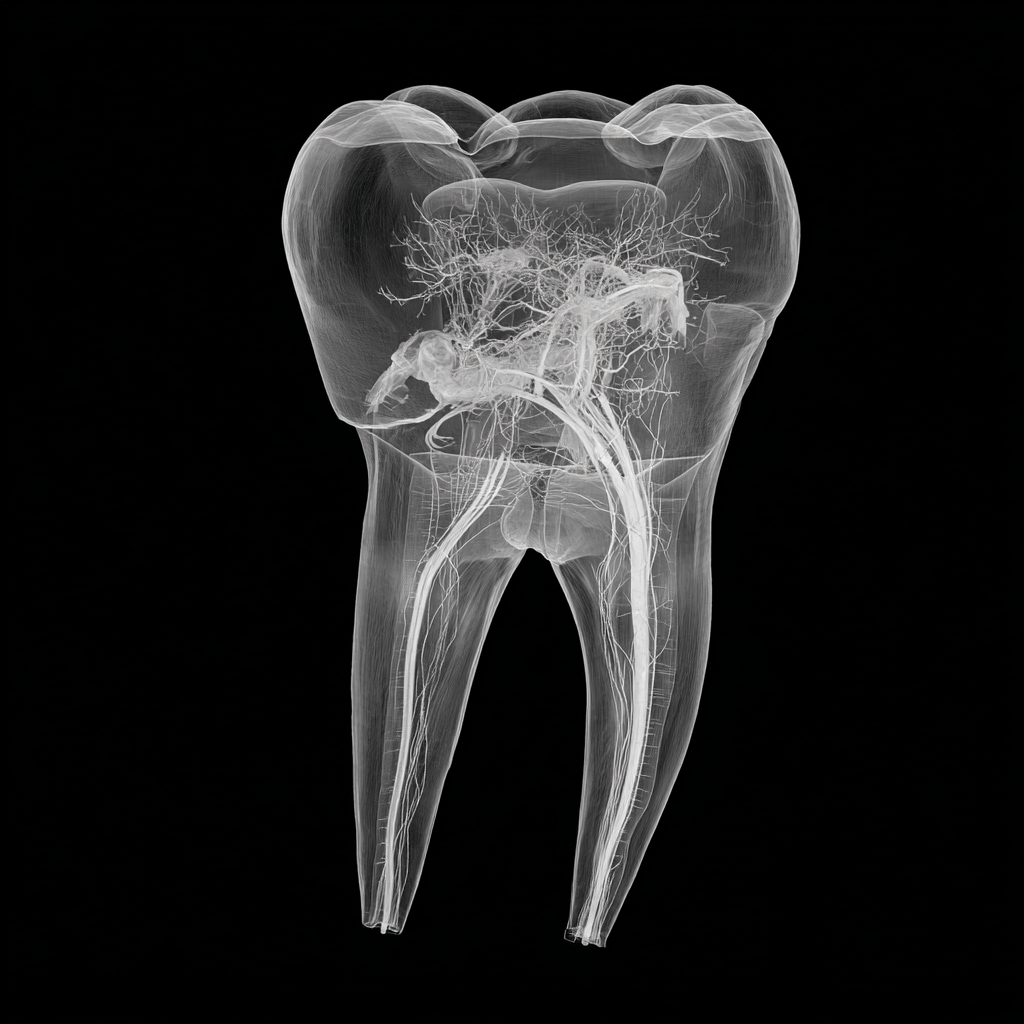
Small Field-of-View CBCT
We use focussed endodontic protocols that capture only the tooth (or teeth) in question, reducing radiation exposure while producing high-resolution images suitable for:
- Cracked tooth assessment
- Pulpal floor mapping
- Complex molar anatomy
- Post-treatment evaluation
- Periapical pathology review
Scans are supplied in DICOM format with JPG slices for easy chairside review. You can also combine findings with OPG scans or other imaging services where appropriate.
More about CBCT scansEndodontic CBCT – Frequently Asked Questions
Will a CBCT scan replace normal X-rays?
No — for most root canal cases, 2D X-rays are sufficient. CBCT is used only when additional detail is required and justified under IRMER. If you are unsure, your dentist or endodontist can refer and discuss the case with us.
Does the scan hurt?
No, it is completely painless. You simply stand still for a few seconds while the scanner rotates.
How long does it take?
The scan itself takes under 20 seconds. File preparation may take 10–15 minutes, after which your dentist will receive the data securely.
Do I need a referral?
Yes — under IRMER regulations, all CBCT scans must be justified by a dentist. You can contact us or ask your dentist to refer you via our For Dentists page.
How much does an endodontic CBCT cost?
Our standard CT Scan price of £137 applies. A radiographic report (if required) is £250. You can see full fees on our Prices page.

Book a CBCT Scan for Root Canal Treatment
Fast appointments, clear pricing and secure digital imaging. View our CBCT prices or contact the team before booking.