
Scan comparison • Birmingham CBCT & OPG Hub
CBCT vs OPG: which dental scan do you need?
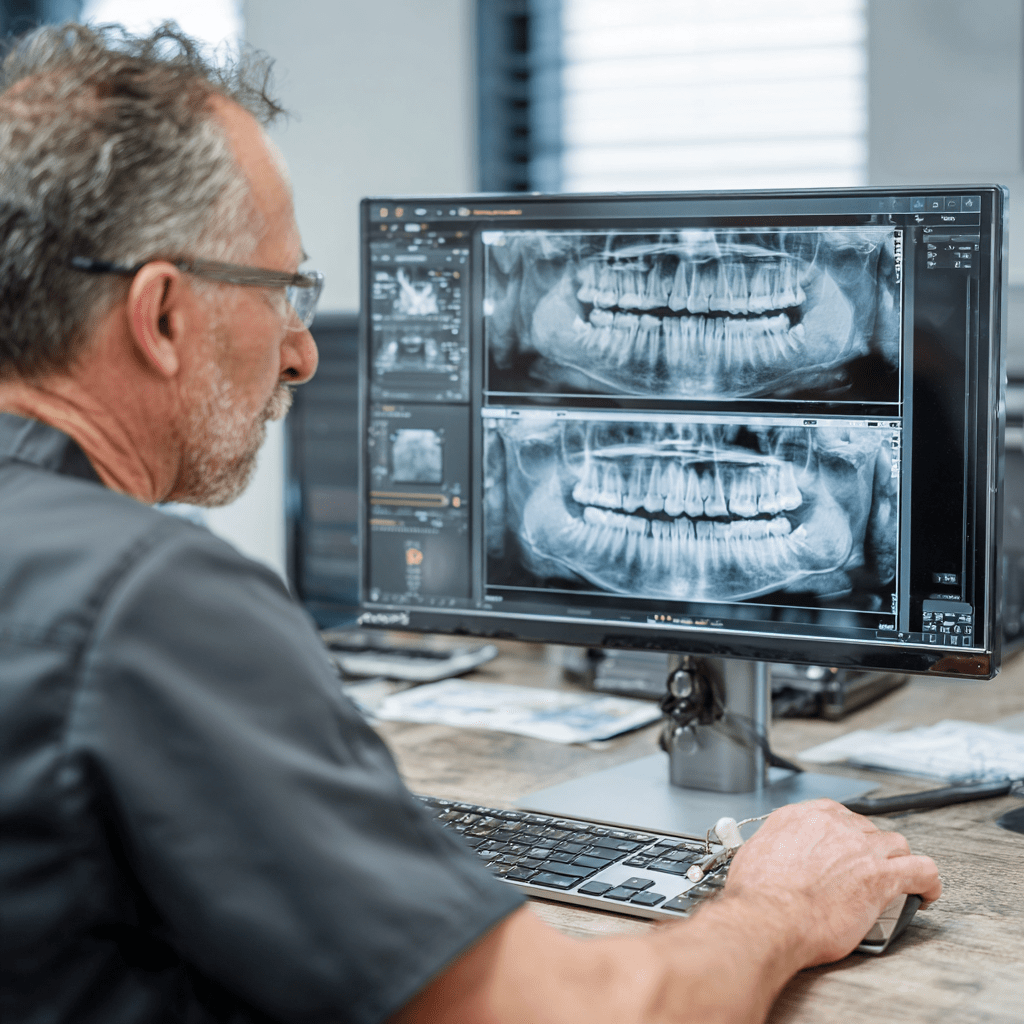
An OPG is a single panoramic picture of all your teeth and jaws. A CBCT is a 3D scan of a chosen area. Neither is better in general. The right scan is the lowest-dose one that answers your dentist’s question.
- GDC regulated
- CQC registered
- IRMER-compliant
Prices
- OPG (including assessment)£79
- CBCT scan£139 per arch
- Radiology report (optional)£115
The short answer
UK selection criteria put it simply: the lowest-dose examination that will answer the clinical question should always be undertaken. In practice, an OPG (or small intraoral X-rays) usually comes first. A CBCT is added when your dentist needs 3D information that a flat image can’t give.
Side by side
| OPG (panoramic X-ray) | CBCT (3D cone beam CT) | |
|---|---|---|
| What you get | One flat image of all the teeth, both jaws and surrounding bone | A 3D volume of a chosen area that can be viewed in slices from any direction |
| Area covered | The whole mouth in one image | From a few teeth up to a large area (our largest is 16 cm × 9 cm) |
| Typical effective dose* | 2.7–38 µSv | Small field 11–214 µSv; larger fields up to several hundred µSv |
| In background-radiation terms* | No more than about six days | Between about two days and six months, depending on machine and settings |
| Limitations | Overlapping structures. UK guidance notes panoramic images can be magnified by up to 30%, and the magnification varies across the image | Higher dose. Metal fillings and crowns can cause streak artefacts. Shows less fine detail than intraoral X-rays for caries |
| Price here | £79 (includes assessment) | £139 per arch |
*Ranges from the UK Selection Criteria for Dental Radiography. UK health protection guidance gives a typical panoramic dose of 24 µSv and puts small-field CBCT at roughly 2 to 27 times that. Individual doses vary with the machine and settings. See also radiation safety.
When an OPG is usually enough
- A general overview before treatment, or a baseline record
- Checking which teeth are present, missing or still developing
- First assessment of wisdom teeth
- Orthodontic assessment
- Bone levels around the teeth (an overview)
- Planning dentures or other full-mouth treatment
More: OPG scans in Birmingham.
When a CBCT adds something an OPG can’t
- Lower wisdom teeth close to the nerve. The OPG suggests a close relationship, and the surgeon needs to see it in 3D. See wisdom teeth scans.
- Implant planning. Bone width, nerve position and the sinus floor need cross-sections. UK guidance suggests limited-volume CBCT where cross-sectional information is needed. See CBCT for implants.
- Impacted canines and root resorption. See CBCT for orthodontics.
- Complex root canal problems. Examples are extra canals, suspected fractures or resorption. See endodontic CBCT.
- Upper roots and the sinus. Research comparing the two found panoramic images often misjudge how close roots are to the sinus. See dental CBCT sinus scan.
- Bony detail of the jaw joint, when clinically indicated. See TMJ scan.
A typical pathway
Many patients start with an OPG. If it answers the question, that is the end of the imaging. If it raises a 3D question, your dentist may then request a CBCT of just the area concerned. That area is often much smaller than the whole mouth, which keeps the dose down. Where a CBCT is needed after an OPG, we can often do it on the same visit. Every scan is justified separately, so having one does not automatically mean having the other.
Cost comparison
- OPG only: £79
- CBCT of one arch: £139 per arch
- OPG followed by a single-arch CBCT: £218
- Optional formal radiology report: £115
- Consultation if you have no referring dentist: £54
A £30 deposit secures an online appointment and is deducted on the day. More detail: what a CBCT scan costs and why.
For referring dentists
If you are unsure whether a CBCT is justified, send the OPG or periapicals with the referral and state the clinical question. We would rather discuss a case than scan a volume that can’t be justified. Small, medium and large fields of view are available, and dose information for your IR(ME)R records can be provided. See for dentists.
Frequently asked questions
Can I just have a CBCT to be on the safe side?
No. UK law requires every X-ray to be justified for you as an individual, and the benefit must outweigh the risk. Using a higher-dose scan when a lower-dose one would answer the question can’t be justified. “Just in case” is not a reason under the regulations.
I’ve had an OPG. Will I need a CBCT as well?
Only if the OPG leaves a specific question unanswered. For example, it may suggest a wisdom tooth root is close to the nerve, or show an implant site where your dentist needs the bone width. Many patients never need the second scan. Where a CBCT is needed after an OPG, we can often do it the same day.
Which is cheaper?
An OPG is £79, including assessment. A CBCT is £139 per arch. A formal radiology report (£115) is optional for either. See prices.
Does either scan show gums or soft tissue?
Not in useful detail. Both are X-ray techniques that show teeth and bone. Soft-tissue questions, such as the jaw joint disc, need other tests such as MRI.
Which one is faster?
Both are quick. An OPG exposure takes seconds, and the appointment is usually 5–10 minutes. A CBCT rotation is usually under 20 seconds, and the appointment is normally around 10–15 minutes.
Ready to arrange a CBCT or OPG scan?
Book online in a few minutes, or call us if you are not sure which scan you need. Dentists can refer with the same form.